Dennis Gaylor
  • Home
  • A Chi Alpha Story
  • Timeline
  • Contact
  • Dennis’ Blog
  • Quotes
  • Resources
  • Photos
  • News

Why I Wrote GROWING A STUDENT MOVEMENT

June 27, 2021
1
1
Share

I (Dennis Gaylor) dedicated my life to Jesus Christ in 1969 following my sophomore year in college. This transforming experience set the trajectory of my life and ministry. The decision I made during one of the most important developmental windows of my young adulthood, between the ages of eighteen and twenty-two, would have far-reaching influence on my years of ministry ahead. I became intensely aware and committed to a career in ministry to college and university students as the context and fulcrum to change the world. I learned of a young ministry known as Chi Alpha (XA) and never looked back. Chi Alpha led the way and I followed.

My introduction to XA began while attending a college retreat in Texas in 1972. In 1973, I participated in a regional student conference known as SALT (Student Activist Leadership Training). By 1974, I was serving as the full-time director of South Texas District Chi Alpha in Houston. 

In 1978, full of youthful idealism, unbounding energy, and creative imagination, my wife, Barbara, and I packed up our two young children, Jennifer and Jason, and all our earthly belongings and headed for Springfield, Missouri, home of the national headquarters of the Assemblies of God (AG). We left Texas that sweltering day in August excited with possibilities. The clarion call in our hearts to serve and help establish the kingdom of God on every college and university campus was compelling and unstoppable. Throughout my next thirty-five years of service in the national office, I continually sensed the need to stay rooted, to remain faithful and committed, and to build and grow XA nationally. Today, I see the fruits of this faithfulness and dedication to serve. 

There are many ways to tell the XA story. Most importantly, it is the story of God’s redemption and love, bringing His kingdom to bear on the university culture and the world. I believe God’s eternal story will continue to bring power to the ministry of XA in the generations to come. 

 This book is written from my vantage point as national director. It offers history, stories, testimonies, memoirs, and my perspective on how the XA ministry began and developed, what it has become, and where it is going. It highlights the spiritual and cultural dynamics that have transpired over time to birth and grow a national ministry and student movement. 

History buffs will not be disappointed with this book. I include facts, names, details, numbers, lists, dates, and charts. There are anecdotes, notable quotes, and personal observations woven into each chapter. 

There is a reason why this book is important. The role of university ministry in advancing the message of Christ’s love throughout the world cannot be emphasized enough. It is not just a place where some twenty million collegians gather on a few acres in buildings dedicated to learning. These students lead the way into the future. Their influence and leadership will shape the world. They will transform organizations, institutions, cultures, and societies for generations to come. Chi Alpha is a thriving national student movement at the center of societal change and influence with unlimited potential for shaping our world for Jesus Christ. 

This story needed to be told and that’s why I wrote the book. 
Why
Related Posts

Why a Disciple-Making Culture

July 19, 2021
0
1

Winfield Bevins in Multiplying Disciples, What Movements Can Teach Us about Discipleship states that The Celtic Movement, The Moravian Movement, and The Methodist Movement were all multiplying discipleship movements. Chi Alpha is a discipleship movement and sees disciple-making to be a deliberate and specific process by which growing or mature Christians assist in the spiritual growth of younger Christians in the context of personal relationship. It is this essential ingredient of relationship which makes disciple-making different from the modern concept of education. Disciple-making is the act of reproducing followers of Jesus Christ. Multiplying discipleship movements distinguish between addition and multiplication illustrated by contrasting what a gifted evangelist with an international reputation would accomplish if 1000 persons gave their lives to Christ every night for one year. It would take him over 10,000 years to win the entire world for Christ. If a disciple-maker won one person each year and trained that person to win one other person each year, it would take only 32 years to win the whole world. Discipleship is not complete until each disciple is released to in turn disciple others; one maturing believer reproducing other maturing believers, to the degree that they are also able to reproduce maturing believers.
David Watson, in his book, Called and Committed, World Changing Discipleship, explained that Jesus’s disciples were to make disciples who would make disciples, ad infinitum . . . a disciple is a follower. A Christian disciple has committed himself/herself to Christ, to walking Christ’s way, and living Christ’s life, and to sharing Christ’s love and truth with others.
Chi Alpha takes the disciple-making mandate in Matthew 28 as essential to our mission on campus. This discipleship culture understands that discipleship results in a complete submission to the Lordship of Christ, life transformation into conformity to Christ, and ministry reproduction.
The movements noted above all utilized of small groups in disciple-making, and this is why these movements advanced the work of Christ in the world. Bobby Harrington, executive director of Discipleship.org offers characteristics, if not, insights, into disciple-making cultures that we can apply as we reflect on our own ministries.

1. Disciple making is motivated by a loving, deep concern for people lost without salvation in Jesus. 

2. Disciple making is the core mission and foundation of the church (campus ministry) and everything the church (campus ministry) does. 

3. Every decision made and every dollar spent passes through the filter: How does this help us to make disciples? 

4. Praying and fasting are significantly entrenched—it happens a couple of times a week and it is intensified in special seasons—asking for God to empower the mission of reaching as many as possible. 

5. Almost everyone has been mobilized to the mission of making disciples. 

6. Church(campus) leaders are focused on continual coaching and sustaining the disciple-making groups, classes, and bands. 

7. There is joyful expectation that everyone a) obeys all of Jesus’ commands and b) joins the mission.

8. Everyone understands the mission and method to be used. 

9. A disciple-making movement regularly results in new church plants, (or in our situation multiplying XA on new campuses, pioneering XA groups). 

Why are we quiet?

February 1, 2022
0
0

Dr. Don Everts, partnered with the Barna Group and the Lutheran Hour Ministries to research how practicing Christians talk about their faith which resulted in The Spiritual Conversation Curve designed to help Christians start spiritual conversations. He notes the Christians’ approach to sharing their faith has changed in 25 years. “Technology and rapid cultural shifts, including the impact of social media, have redefined the ways we communicate. This shifting definition of evangelism and the perceptions of faith sharing from both sides of the conversation: the sharer and the hearer.”

In the research, the fear of giving offense or being rejected is one of the primary barriers for many Christians in talking about Jesus. That is why most of us are quiet. The research reports on the state of our witness. Nearly three-fourths of practicing Christians are afraid to speak up about their faith.

The research findings:

1. We have fewer spiritual conversations.

2. We are uncomfortable with spiritual conversations.

3. Our conversations mention Jesus and the Bible less.

4. Our approach to spiritual conversations mirrors our surrounding culture.

5. We know spiritual conversations need to be initiated.

6. Our spiritual conversations increasingly have a digital element.

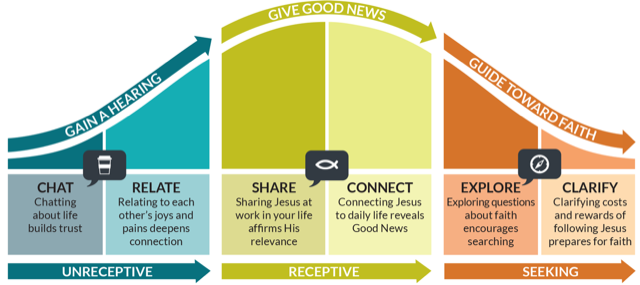
The project led to the creation of The Spiritual Conversation Curve which helps frame how one can start spiritual conversations knowing people have different postures toward the Gospel: unreceptive, receptive, and seeking, and reveals six types of conversations based on their posture: either in gaining a hearing, giving good news, or guiding toward faith. 

In my last blog, “Start to Finish” I explained there are three discernable patterns in a given academic year. Mobilization was the third, predictable pattern that arrives after the new calendar year begins and with Spring.  As the warm weather arrives and in many places snow melts, buds come out on the trees, and the sun shines, students head for the outdoors.

It is an ideal time to step up witness with outdoor activities like lawn talks, contact tables, personal evangelism, and social events, but they focus on the point of this chart and research on spiritual conversations. 

Don admits for him the difficulty of witnessing was “apathy, shyness and basic fear.” He believed spiritual conversations were “pesky, painful, awkward things.” The research shows that most of us in the U.S. are reluctant conversationalists, which he named his book on the research (see Resource). The question asked was, “How often have you had a conversation about faith (or lack of faith) with anyone last year?”

The Spiritual Conversation Curve can help us be aware and sensitive to where people are (or not) in their understanding or experience of faith. Learning to have natural conversations with students you get to know (chatting, relating, sharing) can lead people toward faith—clarifying the costs and rewards of following Jesus. Don has written a 10-page booklet, “How to Talk About Your Faith,” that you can download for free at www.lhm.org/curve/.

_______________

Don Everts is the senior pastor of First & Calvary Presbyterian Church in Springfield, Missouri, and is a writer for Lutheran Hour Ministries (lhm.org) and the Hopeful Neighborhood Project. He served with IVCF for 18 years. Don has spent almost three decades helping people on college campuses and in the local church become good stewards of their God-given gifts. His latest book is The Reluctant Witness. Some might remember his first 1999 IVP book, Jesus with Dirty Feet.

1 Comment
    Valerie Burgess says: Reply
    July 4th 2021, 9:50 pm

    Thanks for committing to the call. May you continue to lead a life of abundant ministry following the same voice to wherever it leads. I am so excited about the fruit Chi Alpha brings in the lives of so many as they too answer the call.

Leave a Reply Cancel reply

Your email address will not be published. Required fields are marked *

Categories

  • A Chi Alpha Story
  • Dennis' Blog
  • News
  • Photos
  • Quotes
  • Resources
  • Uncategorized

Tags

Discipleship Gen Z International Students Research Why
International Students Enrollment Plummetsby Dennis Gaylor / July 5, 2021

Subscribe to get the latest posts from DennisGaylor.com

Add me to your mailing list!

Submit your email, newsletter, snail mail to:
Dennis Gaylor 4435 W. Forest Ridge Rd. Battlefield, MO 65619

Add me to your list!

About Me

Add me to your mailing list. I would love to receive an email update, newsletter, snail mail, or report on your campus ministry, and please friend me on Facebook.

Snail Mail:

4435 W. Forest Ridge Rd. Battlefield, MO 65619
DennisGaylor@gmail.com

Categories

  • A Chi Alpha Story
  • Dennis' Blog
  • News
  • Photos
  • Quotes
  • Resources
  • Uncategorized
  • Facebook

© 2021 DennisGaylor.com. All rights reserved.